
 Facebook
 X
X
 Pinterest
 Copy Link
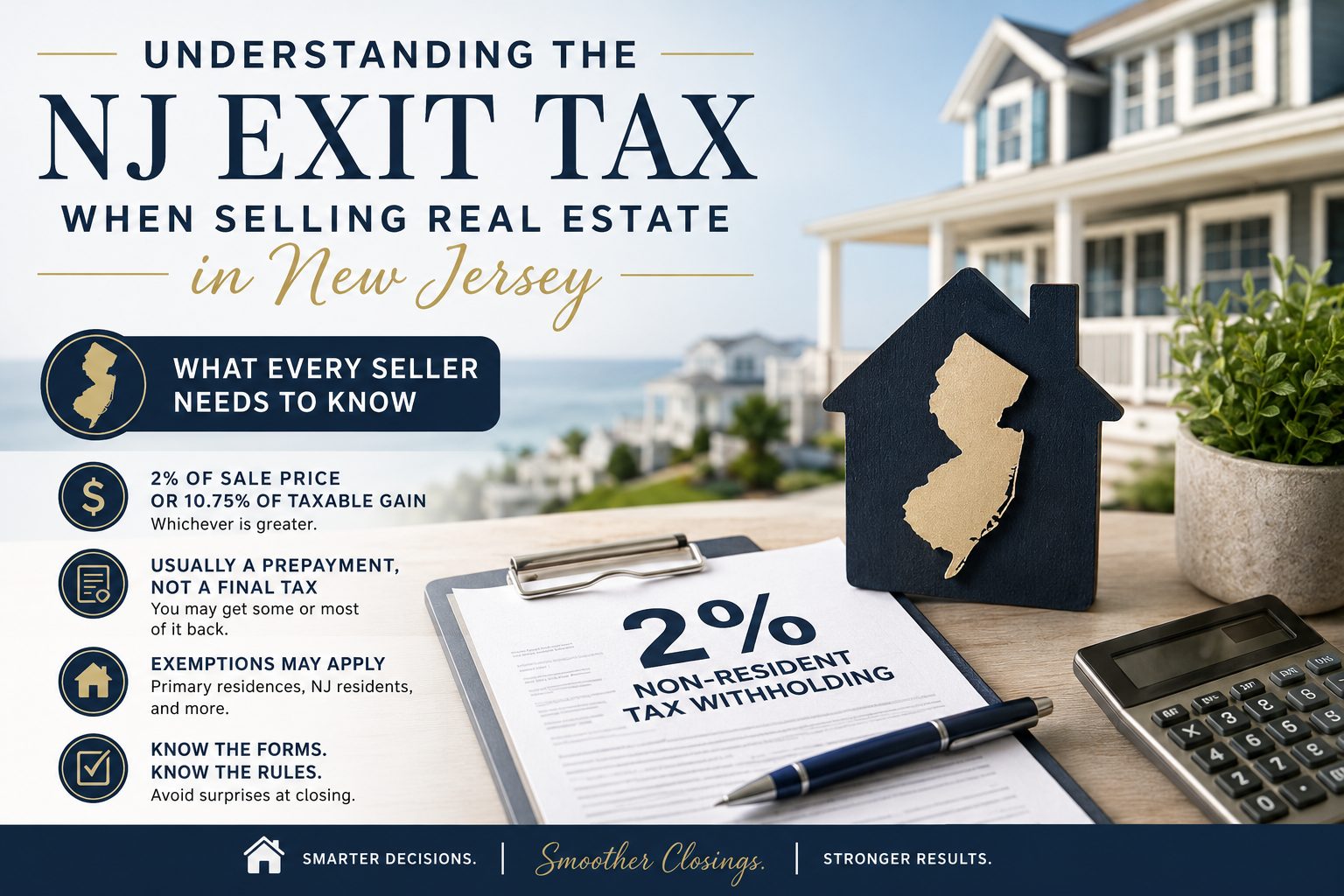
The New Jersey Exit Tax is not actually a separate tax. It is a withholding collected at closing when non-residents sell New Jersey real estate.
Understanding the “NJ Exit Tax” When Selling Real Estate in New Jersey
Are you a homeowner with the following questions?
- What is the NJ Exit Tax?
- Is the NJ Exit Tax really a tax?
- Who pays NJ Exit Tax?
- Can NJ Exit Tax be refunded?
- How do I avoid NJ Exit Tax?
- What are GIT/REP forms?
- Do primary residences qualify for exemptions?
- What happens if I moved out of NJ before selling?
If you’re selling property in New Jersey and moving out of state, you will hear about something called the “NJ Exit Tax.” The name sounds intimidating, but the reality is often misunderstood.
The truth is: New Jersey does not actually charge a separate “exit tax” just because someone leaves the state. What people refer to as the “NJ Exit Tax” is really a tax withholding collected at closing for certain non-resident sellers.
This is what you as a homeowner or seller should know.
What Is the NJ Exit Tax?
The “NJ Exit Tax” is an estimated income tax withholding required when a non-resident sells real estate in New Jersey.
New Jersey requires this withholding to help ensure any taxes owed on profits from the sale are eventually paid.
In most cases, the withholding amount is either:
- 2% of the sale price, or
- 10.75% of the taxable gain,
whichever amount is greater.
For many sellers, the 2% figure is the amount most commonly discussed.
Example of the 2% Withholding
If a home sells for $500,000, the estimated withholding would be:
0.02 X 500,000 = $10,000
This means $10,000 may be withheld at closing and sent to the State of New Jersey.
Is This Money Lost Forever?
Usually not.
In many situations, the withholding acts as a prepayment toward the seller’s New Jersey income taxes. However, after filing a New Jersey non-resident tax return, the seller may receive some or even most of the money back depending on their actual taxable gain.
Who Typically Has To Pay This Tax?
Generally, this applies to:
- Sellers who are no longer New Jersey residents at the time of closing
- Individuals who have already moved out of NJ before selling their property
- Certain investment property owners, who live out of state
Who May Be Exempt?
Many sellers can qualify for exemptions.
You may avoid the withholding if:
- The property is used as your primary residence.
- You qualify for the federal capital gains exclusion under Section 121
- You are still a New Jersey resident at closing
- The proper exemption paperwork is completed
Common Forms Used in NJ Closings
Several forms are commonly used during the closing process:
- GIT/REP-1 – Non-resident seller tax withholding form
- GIT/REP-3 – Seller residency/exemption certification
- GIT/REP-4 – Special waiver request form
During the sales process your attorney, title company, or accountant usually helps prepare these documents.
A Common Misunderstanding
One of the biggest misconceptions is that New Jersey “charges people 2% to leave the state” Which is not technically accurate.
This is simply just an estimated tax withholding connected to the sale of New Jersey real estate by non-residents.
Final Thoughts
In conclusion, if you’re thinking about selling a home in New Jersey and relocating out of state, you must understand how the NJ Exit Tax withholding works before closing day.
Since every seller’s tax situation is different and it is always recommended to speak with a qualified CPA or your real estate attorney.
If you have questions about selling your home in Ventnor, Margate, Longport, Linwood, Northfield, Somers Point or elsewhere South Jersey, pricing your property correctly, or preparing for closing costs, I’d be happy to help guide you through the process.
Give me a call directly at 631-398-3519. I serve sellers across Absecon Island and South Jersey with clarity and care every step of the way.
Matt Bonomini
Coldwell Banker Argus Real Estate
609-822-3700
m.bonomini16@gmail.com
